
What is Business Loan Moratorium: Purpose, Rules & Eligibility
Bullit Team | 2026-04-09
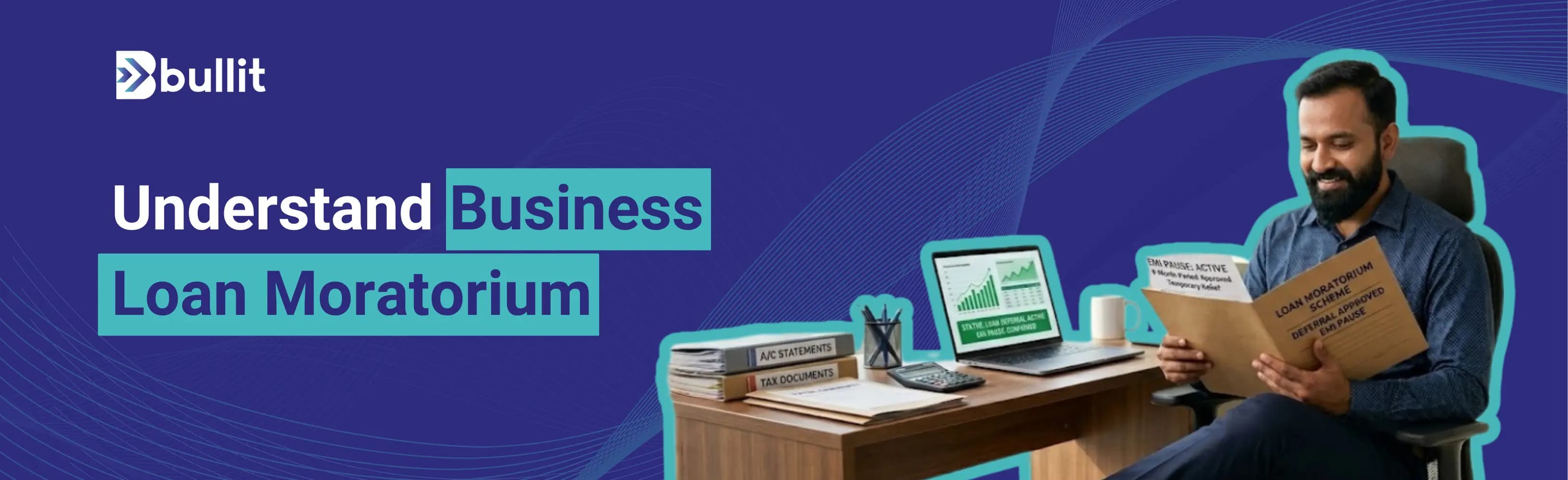
Imagine it’s the 25th of the month and salaries are due in 5 days. Your biggest client has not yet paid, and your EMI is scheduled in three days.
However, you know the money will come, just not in time.
Situations like this are exactly why a business loan moratorium exists. It allows MSMEs to pause loan repayments temporarily when cash flow timing breaks down, without immediately slipping into default.
However, a moratorium is often misunderstood as relief without consequences. In reality, it changes when you pay, not what you owe.
In this blog, let’s clearly understand the meaning of a loan moratorium, how the moratorium period in business loans works, and how it impacts future EMIs, tenure, and total cost.
What is a Business Loan Moratorium?
A business loan moratorium is a lender-approved pause on loan repayments for a specific period. During this time:
EMIs or interest payments may be temporarily deferred
The loan remains active
Interest continues to accrue on the outstanding amount
In simple terms, the loan moratorium means you stop making payments for a while, but the loan continues to accrue interest. It is also important to distinguish it from similar concepts:
Moratorium: Temporary pause in repayment
EMI holiday: An informal term used for similar relief
Loan restructuring: Permanent change in loan terms, such as tenure or EMI
For MSMEs, this distinction matters. A moratorium buys time. Restructuring changes the structure.
What is the Purpose of a Moratorium in Business Loans
Lenders do not offer moratoriums as a favour. They offer them to manage risk when a borrower is temporarily under pressure.
For MSMEs, a moratorium provides:
Immediate business loan repayment relief
Protection from default classification
Time to stabilise operations and cash flow
For lenders, it prevents accounts from slipping into non-performing status and preserves the relationship. A moratorium is typically used in situations such as:
Delayed receivables from clients
Temporary business disruptions
Market slowdowns or external shocks
The key idea is simple: A moratorium is intended for short-term cash-flow mismatches, not long-term financial distress.
How the Moratorium Period in Business Loans Works
The moratorium period in business loans is not uniform. It depends on the loan type and the facility's structure.
For Term Loans:
EMIs are paused for a defined period
The repayment schedule shifts forward
Interest continues to accumulate
This means that the instalments you skip are not cancelled. They are deferred, and the total repayment is recalculated.
A well-known example comes from the RBI’s COVID relief framework, where repayments were deferred for several months, and loan tenures were adjusted accordingly.
For Working Capital Loans:
Working capital loans behave differently because there is no fixed EMI. In such cases:
Interest servicing may be deferred
Interest continues to build during the period
Lenders may later adjust limits or convert accumulated interest
This is why MSMEs should not assume that all moratoriums work the same way. The structure depends on whether the loan is term-based or revolving.
Common Moratorium Structures
Across lenders, moratoriums usually fall into three formats:
Full EMI pause
Principal-only deferment
Interest deferment
The duration can vary from a few months to longer periods, depending on lender policies or broader MSME loan moratorium rules.
One critical point: A moratorium is never automatic. It requires approval and comes with revised repayment terms.
Full EMI Pause vs Principal-Only Moratorium
Not every business loan moratorium works the same way. What actually gets paused depends on how the loan is structured.
Full EMI Pause:
In this structure:
Both principal and interest payments are deferred
No EMI is paid during the moratorium period
Interest continues to accumulate in the background
This is the most common format when lenders offer short-term relief.
Principal-Only Moratorium:
Here:
Interest payments continue
Only principal repayment is postponed
This is often seen in project loans or capital expenditure financing, where lenders expect a gradual revenue build-up before principal repayment begins.
Built-In Moratorium (Upfront):
Some loans are designed with a moratorium from the beginning:
A predefined grace period before EMIs start
Common in new business setups or expansion loans
Across all formats, one principle remains constant: A moratorium changes repayment timing, not the total cost.
What are the Business Loan Moratorium Interest Rules?
This is where most confusion lies. During a business loan moratorium, interest does not stop. It continues to build on the outstanding loan amount.
Now, what does this mean in practice?
Your loan balance increases during the moratorium
Unpaid interest may be added to the principal
Future EMIs or tenure are adjusted accordingly
These are the core moratorium interest rules MSMEs must understand before opting in.
Simple vs Compounding Impact:
Interest can be applied in two ways:
Simple accumulation: Interest is calculated on the original principal
Compounding: Unpaid interest is added to the principal, increasing future interest
In most real-world scenarios, compounding makes the total repayment noticeably higher over time.
Who is Eligible for a Business Loan Moratorium?
Not every MSME automatically qualifies. Moratorium eligibility depends on lender assessment.
Typical Eligibility Factors:
Lenders usually evaluate:
Loan account status (must be standard, not severely overdue)
Repayment track record
Nature of financial stress (temporary vs structural)
Future cash flow visibility
Today, MSME loan moratorium rules are not uniform. They are:
Lender-specific
Case-by-case
Often linked to restructuring frameworks
Why Eligibility Varies
Two businesses may face the same revenue drop, yet only one gets approval. The difference usually comes down to:
Past repayment discipline
Clarity of recovery plan
Overall financial behaviour
A moratorium is not just about need. It is about lender confidence.
When MSMEs Should Consider a Moratorium
A business loan repayment relief tool like this should be used with intent, not by default. Consider a moratorium if:
Payments are delayed but expected soon
Cash flow disruption is temporary
Core business demand remains intact
You need to prioritise salaries or essential expenses
The alternative is default or expensive short-term borrowing
In such cases, a moratorium acts as a bridge. However, there are circumstances when business owners should avoid opting for a moratorium:
Revenue visibility is unclear
The business model is under long-term pressure
Debt levels are already high
Future EMIs may become difficult to sustain
In these situations, the added interest burden can worsen financial stress.
Conclusion
A business loan moratorium is not just a relief mechanism. It is a financial decision with clear trade-offs.
It helps MSMEs manage short-term cash flow disruptions, avoid defaults, and stabilise operations when timing breaks down.
At the same time, it increases the overall cost of borrowing and reshapes future repayment obligations.
The smartest businesses do not treat a moratorium as automatic relief. They treat it as a strategic choice.
Explore more MSME-focused insights, financial tools, and funding guidance at Bullit.