
Major Schemes, Programs and Initiatives by the Government of India
Bullit Team | 2026-06-17
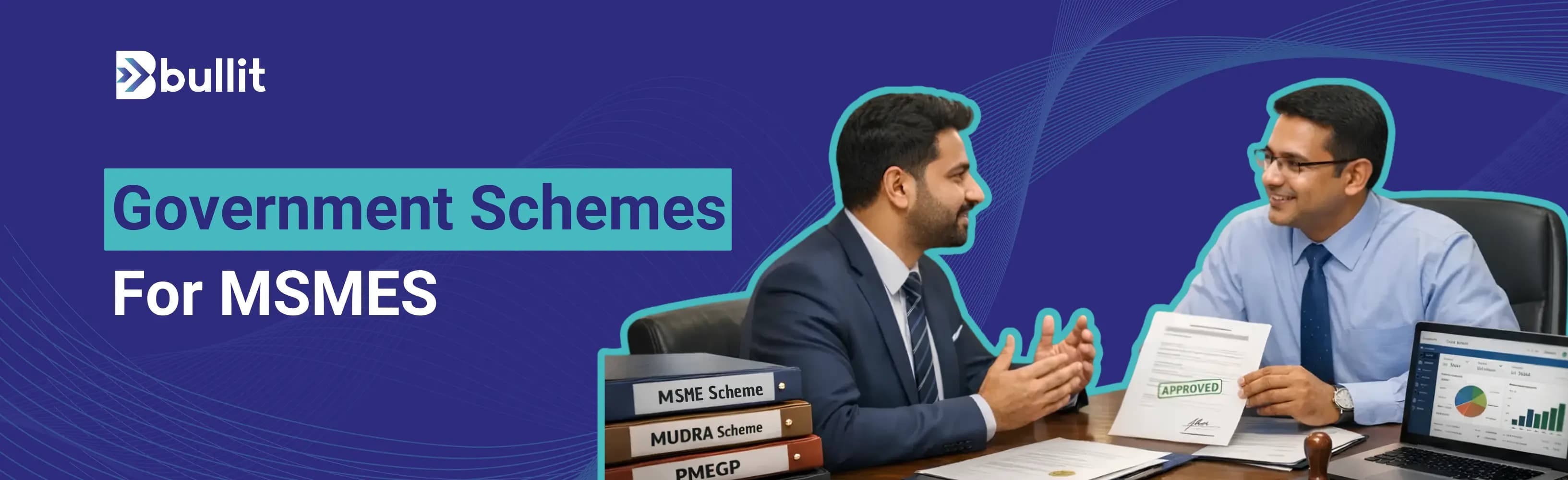
In India, the majority of business owners wake up thinking about delayed payments, rising costs, finding customers, hiring the right people, and figuring out where the next stage of growth will come from.
The challenge is they try to solve these problems entirely on their own, even when support already exists.
Over the years, the Government of India has launched a wide range of MSME Schemes & Initiatives aimed at helping businesses access finance, adopt technology, improve skills, strengthen operations, and compete more effectively.
Yet many entrepreneurs are only familiar with a handful of popular schemes and often miss the larger ecosystem available to them.
In this guide, we look at some of the major schemes, programs, and initiatives introduced by the Government of India and how they support businesses across funding, skill development, infrastructure, technology, and digital governance.
Business Funding MSME Schemes
For most growing businesses, access to capital remains one of the biggest challenges.
A new order may require additional inventory. Expansion may demand equipment purchases. A delayed client payment can suddenly create cash flow pressure. In all these situations, access to funding often determines whether an opportunity is captured or missed.
Recognising this, the government has introduced several schemes that address different financing needs:
1. Prime Minister's Employment Generation Programme (PMEGP) -
The scheme supports entrepreneurs looking to establish new manufacturing or service enterprises through credit-linked subsidies.
For many first-generation business owners, PMEGP serves as an entry point into formal entrepreneurship.
2. Credit Guarantee Fund Trust for Micro and Small Enterprises (CGTMSE) -
Traditionally, lack of collateral has prevented many businesses from accessing formal credit.
CGTMSE addresses this challenge by providing credit guarantee support to lenders, making it easier for eligible businesses to secure loans without pledging significant assets.
3. PM Vishwakarma Scheme -
This scheme offers a more comprehensive support structure. Along with financial assistance, the scheme includes skill training, toolkit incentives, and market linkage support.
The PM Vishwakarma Scheme’s objective is not only to improve incomes but also to strengthen and preserve India's traditional trades.
4. Raising and Accelerating MSME Performance (RAMP) Scheme -
The RAMP scheme is a World Bank-supported Government of India program designed to revitalize the MSME sector.
It focuses on improving competitiveness, strengthening institutions, and enhancing collaboration between the Centre and States.
Instead of addressing a single financing problem, it aims to create a stronger business ecosystem that supports long-term growth.
Taken together, these initiatives show how government support has evolved.
The focus is no longer limited to helping businesses access money. Increasingly, it is about helping them become stronger, more competitive, and better prepared for growth.
MSME Schemes For Building Future Entrepreneurs
Access to funding can help a business start or expand. But capital alone rarely guarantees success.
A growing business also needs leadership, operational knowledge, market understanding, and the ability to adapt as conditions change. This is why entrepreneurship development has become a major focus area within India's business support ecosystem.
1. ASPIRE Scheme.
This scheme has been designed to promote innovation, entrepreneurship, and rural industries. ASPIRE focuses on helping new ventures emerge from grassroots and semi-urban ecosystems. The scheme encourages innovation-led enterprise creation while supporting local economic development.
2. Entrepreneurship and Skill Development Programmes (ESDPs) -
ESDPs help aspiring and existing business owners strengthen managerial, technical, and operational capabilities.
The goal is to ensure that entrepreneurs are not only able to start businesses but also sustain and scale them effectively.
3. Assistance to Training Institution (ATI) Scheme -
The ATI Scheme strengthens institutions responsible for delivering entrepreneurship and skill-development programs across the country.
By improving the quality and reach of training infrastructure, ATI helps create a stronger pipeline of capable business owners.
This reflects an important shift in how business support is being viewed. Earlier, schemes were often designed around financial assistance. Today, there is growing recognition that sustainable growth requires capable entrepreneurs, not just funded businesses.
MSME Schemes For Infrastructure Building
When business owners talk about growth, the conversation usually revolves around funding, customers, or hiring.
Infrastructure rarely comes up. Consider a manufacturer that needs testing facilities but cannot afford a dedicated laboratory. Or a small exporter that needs better logistics support. Or a production unit that would benefit from shared machinery and common facilities.
Building these capabilities independently can be expensive. Building them collectively is often more practical.
This is the idea behind the schemes below:
1. Micro and Small Enterprises Cluster Development Programme (MSE-CDP).
Rather than treating businesses as isolated entities, the scheme promotes cluster-based development. It supports the creation of common facilities, infrastructure upgrades, testing centres, and shared resources that improve productivity and reduce operating costs.
The objective is simple - Help businesses benefit from economies of scale that would otherwise be difficult to achieve individually.
2. Procurement and Marketing Support (PMS) Scheme -
The scheme helps businesses improve visibility, participate in exhibitions and trade events, and strengthen access to domestic and institutional markets.
Because creating a good product is only half the challenge. The other half is ensuring that the right buyers know it exists.
Together, these initiatives reflect a broader understanding of business growth. Success is not driven only by access to capital. It also depends on the ecosystem surrounding the enterprise.
MSME Schemes For Technology Adoption
A decade ago, technology upgrades were often seen as something businesses could postpone.
Today, they have become a competitive necessity.
Whether it is manufacturing quality, operational efficiency, product innovation, or digital adoption, businesses that embrace technology are increasingly outperforming those that do not.
Recognising this shift, the government has introduced several initiatives aimed at helping businesses become more competitive and future-ready:
1. MSME Champions Scheme -
It brings together multiple programs focused on improving competitiveness, innovation, and operational excellence.
2. MSME Sustainable (ZED) Certification Scheme -
The ZED Scheme encourages businesses to adopt zero-defect and zero-effect manufacturing practices.
The focus is on improving quality standards while promoting environmentally responsible production.
3. MSME Competitive (Lean) Scheme
The LEAN Scheme helps businesses adopt lean manufacturing principles.
By reducing waste, improving processes, and increasing efficiency, firms can strengthen profitability without necessarily increasing production capacity.
4. MSME Innovative Scheme -
It supports business incubation, intellectual property creation, design development, and digital transformation initiatives.
5. National Scheduled Caste and Scheduled Tribe Hub (NSSH) -
The scheme focuses on supporting SC/ST entrepreneurs through capacity building, market access, skill development, and enterprise support, helping ensure that growth opportunities are more inclusive.
Taken together, these initiatives highlight a major shift in India's business ecosystem.Government support is no longer focused only on helping businesses survive. Increasingly, it is focused on helping them compete.
Conclusion
India’s MSME policy landscape is no longer centered around a single subsidy or loan product.
It is a connected system of finance, skills, infrastructure, technology, market support, and digital governance.
For entrepreneurs, the opportunity is not just knowing these programs exist. It is understanding which combination works best for their business journey.
That’s where informed guidance is essential.
Explore more MSME resources and financial insights at Bullit.